About me

Enthusiastic and adaptable researcher, lecturer, project manager and data scientist. With a background in evolutionary ecology, genetics, genomics, behavioural ecology and fungal biology. Delivered high quality research, teaching and mentoring to diverse audiences. Experienced in stakeholder engagement and collaborative research.

What I do

  • design icon

    Scientific Research & Project Management

    Experienced project manager with a track record of successfully leading international research projects and grants. Principle invesitgator and collaborator on academic research projects and industry collaborations.

  • camera icon

    Bioinformatics and Data Analysis

    Proficient in bioinformatics tools, statistical analysis and data management of large-scale biological data. Experience with whole genome DNA, RNAseq and Bisulphite sequence analysis, population genomics, and genetic mapping.

  • Web development icon

    Academic Writing

    High cited researcher with over 46 publications in peer-reviewed journals. Secured successful grants for research, fellowships and training programmes.

  • mobile app icon

    Teaching and Mentoring

    Experienced lecturer and mentor of undergraduate and postgraduate students, and organising workshops, field courses and research training programmes for diverse audiences.

This website was created with Claude AI and a tutorial on creating personal portfolios by codewithsadee .

Resume

Experience

  1. Senior Research Assistant

    2020 — 2025

    IBZ, ETH Zürich. 70% Research - 30% Teaching. Evolution of virulence, population genomics and molecular epidemiology of sugar beet pathogen. Whole genome sequence data analysis, population genomics, GWAS, statistical analysis, project management, and PhD supervision.

  2. Researcher

    2019 — 2020

    IBZ, ETH Zürich. 100% Research. Population genomics and adaptation in Epichloe fungal pathogens. Whole genome sequence data analysis, population genomics, selection scan analysis, and PhD supervision.

  3. Fellowship Researcher

    2015 — 2018

    Adaptation to a Changing Environment Fellowship, ETH Zürich. 100% Research. Genomic landscape influences on mutation rate and adaptation. Whole genome sequence, RNA and Bisulphite sequence analysis, greenhouse phenotyping.

  4. Fellowship, University of Sheffield

    2014 — 2015

    60% Research - 40% Teaching. Evolution of colour polymorphism in Anolis lizard. RADseq analysis, lecturer for biology and conservation courses, PhD supervision.

  5. Marie Curie International Fellowship

    2011 — 2014

    Smithsonian Tropical Research Institute (STRI), Panama and University of Sheffield, UK. Evolution of colour polymorphism in Anolis lizard. Project management, captive breeding, RADseq and microsatellite analysis, field surveys, supervision of technical staff.

  6. Postdoctoral Researcher

    2007 — 2010

    University of Sheffield, UK. 100% Research. Genetic mapping in zebra finch (Taeniopygia guttata). Whole genome sequence data analysis, linkage disequilibrium analysis, QTL mapping of beak colour.

  7. Previous Postdoctoral Experience

    2004 — 2007

    University of Witwatersrand, South Africa and Smithsonian Tropical Research Institute (STRI), Panama. Principal investigator of research projects.

Education

  1. Australian National University

    2000 — 2004

    PhD in Zoology, Australian National University, Canberra, Australia.

  2. Australian National University

    1997 — 1998

    Honours in Zoology, Australian National University, Canberra, Australia.

  3. James Cook University

    1994 — 1996

    Bachelor of Science in Environmental Science, James Cook University, Townsville, Australia.

Professional Development

Training Courses Attended

  • AI-based tools for scientific writing and research (ETHZ)
  • Bioinformatics for Adaptation Genomics (ETHZ)
  • Summer Institute in Statistical Genetics: Quantitative Genetics, MCMC for Genetics, QTL Mapping (University of Washington)
  • Transposable Elements (Physalia Course, Berlin)
  • Next Generation Population Genomics for Non-model Taxa (Cornell University)
  • RADseq Workshop (Smithsonian Tropical Research Institute)

Leadership and Science Communication Training

University of Sheffield:

  • Graduate Mentoring Programme
  • Challenge of Supervising others
  • Designing Lectures
  • Communicating with Impact MasterClass
  • Research Impact
  • Writing for Publication Programme
  • Research Leadership Development Program

Independent Learning

  • Using Python for Research (EdX Harvard University)
  • Coding, Data analysis, web design with AI agents using Visual Studio Code

My skills

  • Bioinformatics and Data Analysis
    80%
  • Academic Writing
    90%
  • Research Project Management
    70%
  • Teaching and Supervision
    80%

Publications

I have 46 peer-reviewed publications atttracting over 3000 citations. For a complete list of my publications, please visit my Google Scholar profile

Recent Publications
  • Firas, T., Stapley, J. & McDonald, B. A. (2026) A new method to measure EC₅₀ reveals cultivar-specific fungicide resistance and very high diversity within experimental field populations of Zymoseptoria tritici, Pest Management Science https://doi.org/10.1002/ps.70483

  • Chen, C., Keunecke, H., Neu, E., Kopisch-Obuch, F. J., McDonald, B. A., & Stapley, J. (2025). Molecular epidemiology of Cercospora leaf spot on resistant and susceptible sugar beet hybrids. Plant Pathology, 74(1), 69–83. https://doi.org/10.1111/ppa.13998

  • Jade, E., Littlejohn, M. D., Eketone, K., Spelman, R. J., Stapley, J., & Santure, A. W. (2025). An Increase in Male Recombination Rate With Age in Dairy Cattle Is Heritable and Polygenic. Journal of Animal Breeding and Genetics, jbg.12948. https://doi.org/10.1111/jbg.12948

  • Pirani, R. M., Arias, C. F., Curlis, J. D., Nicholson, D. J., Stapley, J., McMillan, W. O., Cox, C. L., & Logan, M. L. (2025). The genetic basis of a colorful signal: The polymorphic dewlap of the slender anole (Anolis apletophallus). Heredity. https://doi.org/10.1038/s41437-025-00763-z

  • Stapley, J., Zhong, Z., & McDonald, B. A. (2025). Mapping genomic regions associated with temperature stress in the wheat pathogen Zymoseptoria tritici. G3: Genes, Genomes, Genetics, 15(6), jkaf094. https://doi.org/10.1093/g3journal/jkaf094

  • Chen, C., Keunecke, H., Bemm, F., Gyetvai, G., Neu, E., Kopisch-Obuch, F. J., McDonald, B. A., & Stapley, J. (2024). GWAS reveals a rapidly evolving candidate avirulence effector in the Cercospora leaf spot pathogen. Molecular Plant Pathology, 25(1), e13407. https://doi.org/10.1111/mpp.13407

  • Peona, V., Martelossi, J., Almojil, D., Bocharkina, J., Bräunström, I., Brown, M., Cang, A., Carrasco-Valenzuela, T., DeVries, J., Doellman, M., Elsner, D., Espinoza-Hernández, P., Montoya, G. F., Gaspar, B., Zagorski, D., Hałakuc, P., Ivanovska, B., Laumer, C., Lehmann, R., …Suh, A. (2024). Teaching transposon classification as a means to crowd source the curation of repeat annotation – a tardigrade perspective. Mobile DNA, 15(1), 10. https://doi.org/10.1186/s13100-024-00319-8

  • Treindl, A. D., Stapley, J., Croll, D., & Leuchtmann, A. (2024). Two-speed genomes of Epichloe fungal pathogens show contrasting signatures of selection between species and across populations. Molecular Ecology, 33(4), e17242. https://doi.org/10.1111/mec.17242

  • Sabolič, I., Mira, Ó., Brandt, D. Y. C., Lisičić, D., Stapley, J., Novosolov, M., Bakarić, R., Cizelj, I., Glogaski, M., Hudina, T., Taverne, M., Allentoft, M. E., Nielsen, R., Herrel, A., & Štambuk, A. (2023). Plastic and genomic change of a newly established lizard population following a founder event. Molecular Ecology, e17255. https://doi.org/10.1111/mec.17255

  • Stapley, J., & McDonald, B. A. (2023). Quantitative trait locus mapping of osmotic stress response in the fungal wheat pathogen Zymoseptoria tritici. G3: Genes, Genomes, Genetics, 13(12), jkad226. https://doi.org/10.1093/g3journal/jkad226

Highly Cited Reviews
  • Stapley, J., Feulner, P. G. D., Johnston, S. E., Santure, A. W., & Smadja, C. M. (2017). Variation in recombination frequency and distribution across eukaryotes: Patterns and processes. Philosophical Transactions of the Royal Society B: Biological Sciences, 372(1736), 20160455. https://doi.org/10.1098/rstb.2016.0455

  • Stapley, J., Reger, J., Feulner, P. G. D., Smadja, C., Galindo, J., Ekblom, R., Bennison, C., Ball, A. D., Beckerman, A. P., & Slate, J. (2010). Adaptation genomics: The next generation. Trends in Ecology & Evolution, 25(12), 705–712. https://doi.org/10.1016/j.tree.2010.09.002

Research

Fungal Plant Pathogen Genetics & Genomics

Evolution of virulence and population genomics of Cercospora beticola

Fungal plant pathogens have enormous economical, ecological and societal impacts. Development of crop varieties that can resist pathogens can provide economical and ecologically-friendly approaches to disease control. However, disease resistant crops may lose their effectiveness when pathogens evolve counter measures to increase their virulence against new crop varieties. Understanding the emergence of virulence in fungal pathogens can be useful for developing more effective strategies to mitigate the impact of pathogens in agro-ecosystems.

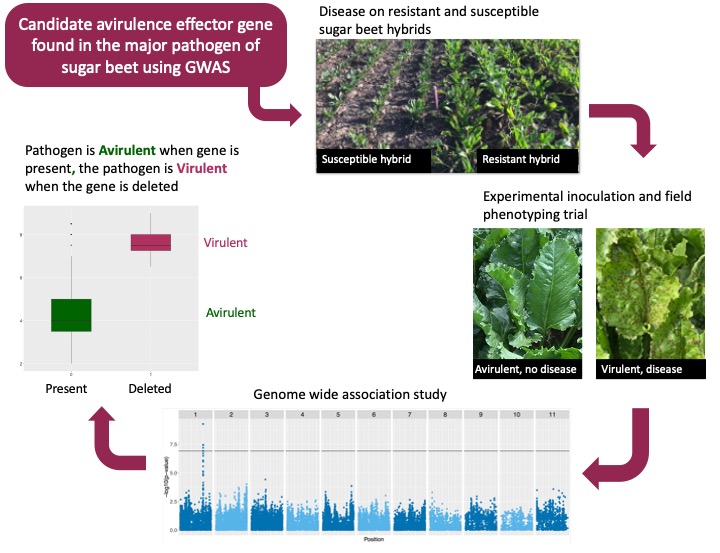
We studied the emergence of virulence in the fungal pathogen of sugar beet, Cercospora beticola, in the field, tested the virulence of isolates in field trials and performed a GWAS to search for putative candidate genes responsible for virulence against a newly developed sugar beet resistant hybrid plant. We identified a single effector gene that was associated with virulence. Deletion or inactivation of the gene enabled C. beticola to infect the resistant plant hybrid. We observed rapid evolution of virulence and have identified the putative candidate gene at the very onset of the evolution of virulence against this resistant plant hybrid.

Key Publication: Chen C, Keunecke H, Bemm F, Gyetvai G, Neu E, Kopisch-Obuch F, McDonald BAM, Stapley J, 2023, GWAS reveals a rapidly evolving candidate avirulence effector in the Cercospora leaf spot pathogen, Molecular Plant Pathology 25(1):e13407.
https://doi.org/10.1111/mpp.13407

Avirulence effector in Cercospora beticola

Quantitative Trait Loci Mapping in Zymoseptoria tritici

Identifying the molecular mechanisms underlying stress responses in plant pathogens provides greater fundamental understanding of how fungi regulate stress, but can also be important for effective control strategies. Furthering our knowledge into how pathogens may adapt to climate change and providing novel antifungal targets.

Our current work is using Quantitative trait loci (QTL) mapping of in vitro phenotypic traits measured under salt and temperature stress in Zymoseptoria tritici to identify possible candidate genes for salt and temperature stress tolerance.

Key Publications:

  • Stapley J, Zhong Z and McDonald BAM (2025) Mapping genomic regions associated with temperature stress in the wheat pathogen Zymoseptoria tritici, G3: Genes, Genomes, Genetics 15(6)
    https://doi.org/10.1093/g3journal/jkaf094
  • Stapley J and McDonald BAM, 2023, Quantitative trait locus mapping of osmotic stress response in the fungal wheat pathogen Zymoseptoria tritici, G3: Genes, Genomes, Genetics 13(12)
    https://doi.org/10.1093/g3journal/jkad226

Population and Adaptation Genomics

I have a long standing interest in understanding how organisms cope with the challenges they face and how this drives phenotypic and genome evolution. Recent advances in genomic techniques are providing great insights into understanding population genomics, speciation, adaptation and phenotypic evolution.

Key Publications:

  • Mira O, Brandt D, Lisičić D, Stapley J, Novosolov M, Bakarić R, Cizelj I, Glogoški M, Hudina T, Taverne M, Allentoft ME, Nielsen R, Herrel A and Štambuk A, 2023 Plastic and genomic change of a newly established lizard population following a founder event. Molecular Ecology,
    https://doi.org/10.1111/mec.17255
  • Treindl AD, Stapley J, Croll D and Leuchtmann A, 2023, Two-speed genomes of Epichloe fungal pathogens show contrasting signatures of selection between species and across populations, Molecular Ecology
    https://doi.org/10.1111/mec.17242
  • Treindl AD, Stapley J and Leuchtmann A, 2023, Genetic diversity and population structure of Epichloe fungal pathogens of plants in natural ecosystems, Frontiers in Ecology and Evolution
    https://doi.org/10.3389/fevo.2023.1129867
  • Stapley J, Reger J, Feulner PGD, Smadja C, Galindo J, Ekblom R, Bennison C, Ball A, Beckerman AP and Slate J. (2010) Adaptation Genomics: the next generation, Trends in Ecology and Evolution
    https://doi.org/10.1016/j.tree.2010.09.002
  • Kokko H, Chaturvedi A, Croll D, Fischer MC, Karrenberg S, Kerr B, Rolshausen G and Stapley J. (2017) Can evolution supply what ecology demands? Trends in Ecology and Evolution
    https://doi.org/10.1016/j.tree.2016.12.005
  • Rodríguez-Verdugo A, Buckley J and Stapley J. (2017) Genomic basis of eco-evolutionary dynamics (Meeting Review) Molecular Ecology
    https://doi.org/10.1111/mec.14045

Mutation and Recombination: Genomic Engines of Adaptation

Adaptation is determined by two fundamental parameters: mutation, that generates heritable genetic variation, and recombination, that determines the efficacy of selection to fix beneficial adaptive alleles. These parameters influence the genomic context of an adaptive allele and the adaptive potential of a population or species. How these evolutionary parameters evolve is a long-standing question in evolutionary biology and a focus of my research.

Variation in Mutation Rate: Mutations are the ultimate source of genetic variation, and mutation rate can vary temporally and spatially. One of my projects studied how stress influenced mutation rate in Arabidopsis. Another was investigating how Transposable elements (TEs) are involved in adaptation and how these may contribute to the success of invasive species.

Variation in Recombination Rate: Recombination is a process where DNA is chopped and then swapped between parental chromosomes during meiosis. The swapping of DNA from each parent creates novel combinations of genetic variants and helps species adapt and respond to changing environments and cope with pathogens and parasites. The recombination frequency and position has an enormous influence on many aspects of biology. Understanding why variation in recombination exists is a major challenge in biology.

Key Publication: Stapley J, Feulner PGD, Johnston SE, Santure AW, Smadja CM (2017) Variation in recombination frequency and distribution across Eukaryotes: patterns and processes. Philosophical Transactions of the Royal Society B: Biological Sciences 372
https://doi.org/10.1098/rstb.2016.0455

Colour Trait Evolution and Genetics

Colour trait evolution and genetics

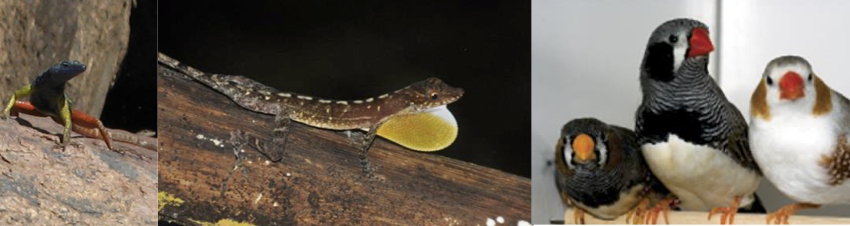
Evolution of Dewlap Colour-Pattern Variation in Anolis Lizards: Understanding the evolution and maintenance of phenotypic variation is a major goal in evolutionary biology. My Anolis work combined experimental, field and genomic approaches to understand the evolution of dewlap colour in Anolis lizards.

Mapping Plumage Variants in the Zebra Finch: Variation in pigmentation often underlies many tractable and interesting questions in evolutionary biology, such as speciation, adaptation and sexual selection. In the zebra finch we have identified candidate genes for red beak colouration.

Ultraviolet Signalling in Flat Lizards, Platysaurus broadleyi: Male competition is a driving force in the evolution and exaggeration of male traits, and colourful male badges are a striking example of this. Ultraviolet (UV) colour badges are an interesting example of colourful signals that while invisible to us are used extensively in a range of other taxa. We investigated how UV signals were used during male contests in the Augrabies flat lizard.

Key Publications:

  • Pirani RM, Arias CF, Curlis JD, Nicholson DJ, Stapley J, McMillan WO, Cox CL and Logna ML (In press) The genetic basis of a colorful signal: the polymorphic dewlap of the slender anole (Anolis apletophallus), Heredity
    https://doi.org/10.1038/s41437-025-00763-z
  • Stapley J, Wordley C, and Slate J. (2011) No evidence of genetic differentiation between Anoles with different dewlap color patterns, Journal of Heredity
    https://doi.org/10.1093/jhered/esq104
  • Wordley CR, Slate J and Stapley J. (2010) Mining online genomic resources in Anolis carolinensis facilitates rapid and inexpensive development of cross-species microsatellite markers for the Anolis lizard genus. Molecular Ecology Resources
    https://doi.org/10.1111/j.1755-0998.2010.02863.x
  • Mundy N, Stapley J, Bennison C, Tucker R, Twyman H, Kang-Wook K, Burke T, Birkhead TR, Andersson S, Slate J. (In press) Red ketocarotenoid pigmentation in the zebra finch is controlled by a cytochrome P450 gene cluster. Current Biology
    https://doi.org/10.1016/j.cub.2016.04.047
  • Stapley J and Whiting MJ. (2006) UV signals fighting ability in a lizard. Biology Letters
    https://doi.org/10.1111/j.1469-1795.2005.00049.x

Avian Genome Evolution

Genetic Linkage Map of the Zebra Finch Genome: The Zebra finch is a model species in evolutionary biology and neurobiology. A limitation to identifying genes underlying variation in traits has been a lack of genomic resources in this species. To help address this problem and complement the zebra finch genome sequence we developed a first generation linkage map for the zebra finch using SNPs. The linkage map provided much insight into the evolution of avian genomes.

Patterns of Linkage Disequilibrium and Recombination across the Zebra Finch Genome: The pattern of linkage disequilibrium across the genome provides valuable insight into the distribution of recombination events, and also has important implications for gene mapping studies. Using the genetic linkage map and the recently completed whole genome sequence we analysed the genome-wide pattern of linkage disequilibrium (LD) and recombination rate in the zebra finch. The analysis revealed unusual patterns of LD and interesting differences between the macro- and microchromosomes.

Key Publication: Stapley J, Birkhead TR, Burke T and Slate J. (2008) A linkage map of the zebra finch Taeniopygia guttata provides new insight into avian genome evolution. Genetics 179:651-667
https://doi.org/10.1534/genetics.107.086264

Teaching

Undergraduate Teaching

2020-2025 Lecturer ETH Zürich
Population and Quantitative Genetics.

2014-2015 Teaching Associate, The University of Sheffield
3rd year Dissertation, 1st and 2nd year Skills for Biologists and 3rd year Conservation Issues and Management.

2000-2004 Undergraduate Lecturer, ANU and Canberra Institute of Technology
Australian Wildlife (ANU); Forensic Biology and Rare and Threatened Species Conservation.

Guest Lecturer, Tutor, Small Group Teaching, Field Course Tutor
Genetics, Population Community Ecology, Behavioural and Evolutionary Biology, Vertebrate Physiology, Tropical Field Course in Borneo and Panama

Supervision and Mentoring

  • 2019-25: Main-supervisor of PhD candidate, ETH Zürich
  • 2019-20: Co-Supervisor of PhD candidate, ETH Zürich
  • 2014-15: Graduate Thesis Mentor, The University of Sheffield (Recognised as an outstanding mentor in 2014 and 2015)
  • 2010-13: Supervisor of STRI Interns, Assistants and volunteers

Training Workshops Organised and/or Taught

  • 2019: Adaptation Genomics, Berlin (Organiser and Instructor)
  • 2017: Equal Opportunity Event: Let's Redress the Leaky Pipeline ETHZ (Organiser)
  • 2017, 2018: Winter School for Whole Genome Sequence Assembly, Annotation and Analysis, ETHZ (Organiser and Instructor)
  • 2015: R Bootcamp, University of Zagreb, Croatia (Teaching Assistant)
  • 2015: Rants 'n Raves: Networking and Communication Event, The University of Sheffield (Organiser/Instructor)
  • 2014-15: Doctoral Development Program: Research Ethics and Integrity, The University of Sheffield (Instructor)
  • 2014: NBAF Training Workshop in Population Genomics, University of Liverpool (Organiser and Instructor)
  • 2014: Collaborative Paper Writing, The University of Sheffield (Organiser)
  • 2013: Let's Get Visible: An event to promote researcher visibility and Designing an Effective Lecture, The University of Sheffield (Organiser)
  • 2008: Advanced Statistics for Biologists using R, The University of Sheffield (Teaching Assistant)

Data Analysis

Statistical Analysis in R

  • Statistical testing: parametric (anova, t-test),non-parametric (Wilcox), linear models (lm), correlation (cor.test), cross- or auto- correlation (acf), dimension reduction (princomp)
  • Advanced statistical modelling: mixed effect modelling (lme4), non-normal linear modelling (glm, GLMMadaptive), non-linear mixed modelling (nlme), survival and time to event modelling (survival), model selection, multi-model inference (MuMIn)
  • Data visualization: ggplot2 and topr
  • Heritability Estimation: Calculating trait heritability using Bayesian methods in hibayes and repeated measures models in MCMCglmm

Bioinformatic Skills

Experienced in designing and running end-to-end bioinformatics pipelines for the analysis of large-scale genomic data.

Genome Assembly and Annotation

  • De novo Genome Assembly: Experience in assembling genomes from Oxford Nanopore and Illumina data using tools like miniasm and ABySS
  • Structural & Functional Annotation: Implementing homology-based and ab initio gene prediction pipelines including Funannotate, CodingQuarry-PM, GeMoMa, MAKER, and SNAP
  • Repetitive Element Analysis: Identification, classification, and manual curation of transposable elements (TEs) using RepeatMasker, RepeatModeler, Censor, and REPET
  • Assembly Validation: Using BUSCO and CEGMA to assess the completeness of genome assemblies

Variant Discovery and Genotyping

  • Pipeline Development: Expertise in high-confidence variant calling using GATK, VCF-file manipulation using bcftools and vcftools
  • Short-Read Processing: Data cleaning and mapping using Trimmomatic, Adapter-Removal, BWA-MEM, and Bowtie2
  • SNP & Microsatellite Discovery: Mining EST databases and transcriptomes to design marker assays using QualitySNP, SPUTNIK, and Primer3
  • Pooled Sequencing (Pool-seq): Aligning and analyzing pooled population data using the PoolParty pipeline

Genetic Mapping and GWAS

  • Linkage Map Construction: Building framework and comprehensive genetic maps with Cri-Map (v2.4 and v2.507), including specialized functions like AUTOGROUP, BUILD, and CHROMPIC
  • Genome-Wide Association Studies (GWAS): Conducting quantitative, binary, and k-mer based GWAS using GAPIT and GEMMA
  • QTL Mapping: Scanning for quantitative trait loci using linear mixed-effects models in the R package qtl2, while controlling for individual relatedness
  • Recombination Rate Analysis: Estimating and modeling recombination rates and crossover events across genomes using LINKPHASE3
  • Pedigree Reconstruction: Reconstructing relationships and parentage from marker data using COLONY and KinInfor

Population Genomics and Selection Scans

  • Genetic Structure Analysis: Determining population clusters and ancestry using STRUCTURE, fastSTRUCTURE, DAPC, and PCA (via SNPRelate)
  • Signatures of Selection: Identifying selective sweeps using extended haplotype homozygosity (iHS, XP-EHH via REHH) and allele frequency spectrum shifts (CLR via SweeD)
  • Population Statistics: Estimating diversity and differentiation metrics including nucleotide diversity (π), Tajima's D, and FST (using vcftools and PoPoolation)
  • Haplotype Phasing: Inferring chromosomal phase and haplotypes using fastPHASE and simwalk2
  • Linkage Disequilibrium (LD): Modeling LD decay and pruning markers for independence using PLINK
  • Phylogenomics: SNP-based phylogeny using RAxML and coalescent-based analyses

Transcriptomics and Functional Analysis

  • RNAseq Analysis: Mapping reads with STAR or BWA-MEM and quantifying gene expression with Rsubread
  • Differential Gene Expression (DGE): Identifying significantly up- or down-regulated genes across conditions using edgeR
  • Pathway & GO Enrichment: Performing Gene Ontology (GO) and KEGG pathway enrichment analyses using topGO and clusterProfiler
  • Effector & Protein Prediction: Predicting protein functions and domains using EffectorP, InterProScan, TOPCONS, and TMHMM

Programming Skills

  • UNIX & HPC: Experienced in working with UNIX and high-performance computing (HPC) environments, coding in Bash and Python
  • Shell Scripting: Job submission and pipeline automation with Slurm and Load Sharing Facility (LSF)
  • Python & Bash: Data processing, automation, and bioinformatics scripting
  • Software Management: Experience installing, configuring, and maintaining software on HPC systems
  • Version Control: Git and GitHub